From Single Gates to Small Circuits
You now know how individual logic gates behave: AND insists on full agreement, OR is happy if anyone says yes, XOR rewards disagreement, and NOT flips whatever it sees.
But real computation requires multiple steps. That's where small circuits come in. A circuit is simply several gates connected together so that the output of one gate becomes the input to another.
In this reading, you will learn how to trace these circuits step-by-step and predict their output for any given set of inputs.
How to Read a Circuit
When you encounter a circuit, use this simple process:
- Start at the inputs (usually labeled A, B, C).
- Find a gate whose inputs you already know.
- Compute that gate's output as a new intermediate value.
- Feed that value into the next gate.
- Continue until you reach the final output.
We'll practice this process using small, approachable circuits designed to build your intuition.
Example 1 — NOT Feeding Into AND
This is a two-gate circuit that shows how one gate's output becomes the input to another.
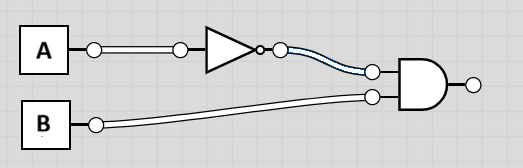
Step-by-step
- Compute NOT A.
- Feed NOT A and B into the AND gate.
- AND outputs 1 only when both NOT A and B are 1.
Notice that the circuit outputs 1 only when A = 0 and B = 1.
Example 2 — OR Feeding Into NOT
This circuit takes a combined condition from an OR gate and then flips it using NOT.
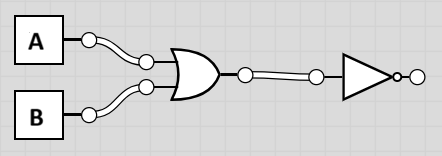
Step-by-step
- Compute A OR B.
- Compute NOT(A OR B).
This circuit outputs 1 only when both A and B are 0. (This is also how a NOR gate behaves.)
Example 3 — AND and XOR Working Together
This circuit shows how two ideas can combine: agreement between A and B, and disagreement between B and C.
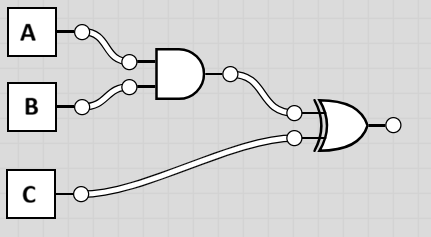
Step-by-step
- Compute D = A AND B.
- Compute Output= D XOR C.
This circuit outputs 1 whenever A and B are both 1 but C is 0, or whenever C is 1 but at least one of A and B are 0.
Strategies for Solving Any Circuit
- Label everything. A, B, C become D, E as intermediate values.
- One gate at a time. Never try to do it all at once.
- Use mini truth tables when in doubt.
- Remember gate personalities: AND demands, OR accepts, XOR disagrees, NOT flips.
- Look for patterns. Circuits often reuse shapes and structures.
Why These Skills Matter
Understanding small circuits is an important step toward understanding how real CPUs work. Arithmetic units, comparisons, decision-making, and control flow are all built from circuits just like these.
These models also give you language and confidence to explain to K-12 students what the hardware is actually doing when it manipulates bits.